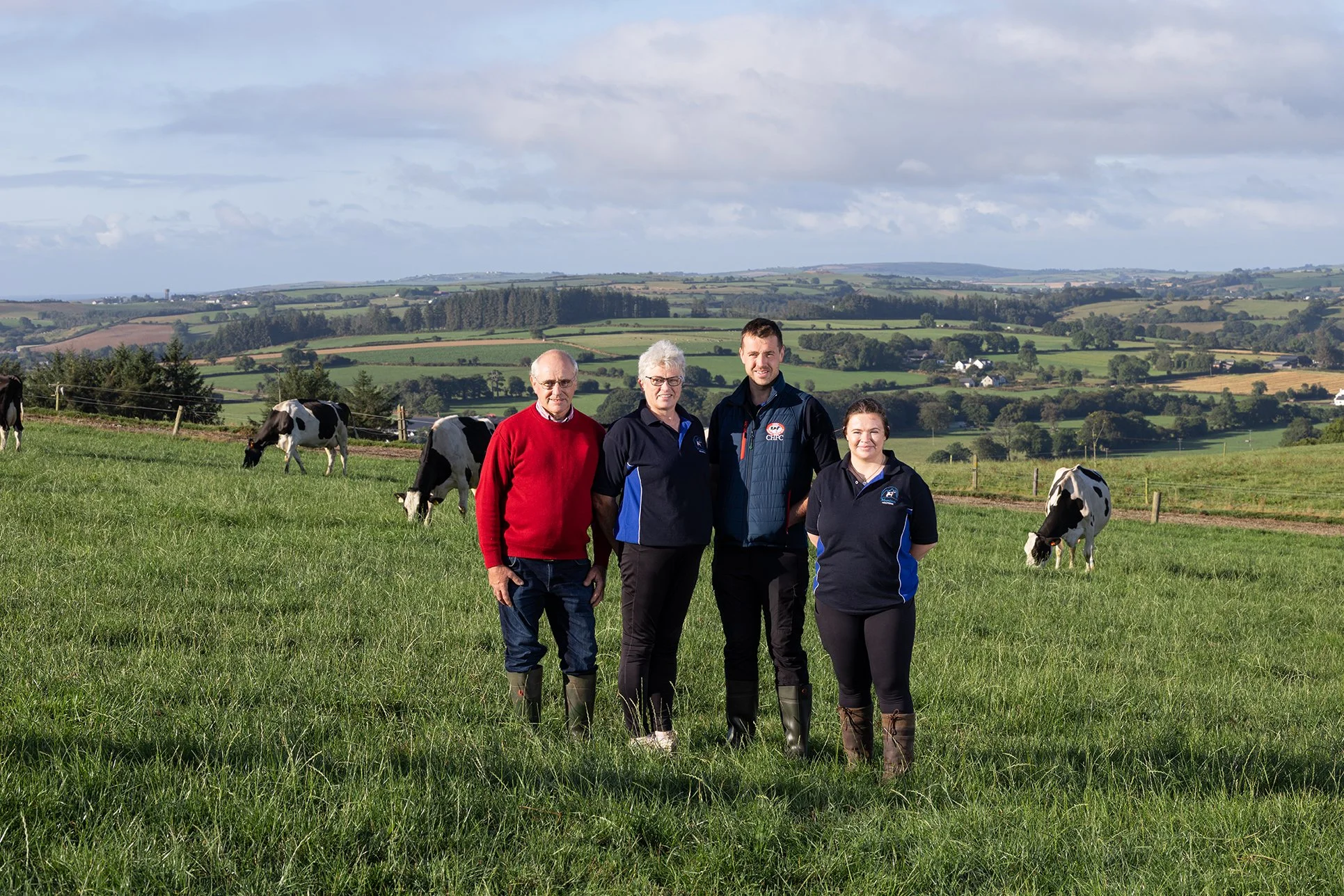
Fame, Zoe, Nuala, Honey, Linda and Patsy. Listen to the Kirbys talking about their herd and before long you realise that these are not simply names in a herd book. They are cow families, with histories, daughters and granddaughters - and at Mounteen, breeding good cows is as much a fascination as it is a business. That probably tells you more about John and Theresa Kirby and their family than any set of milk figures ever could.
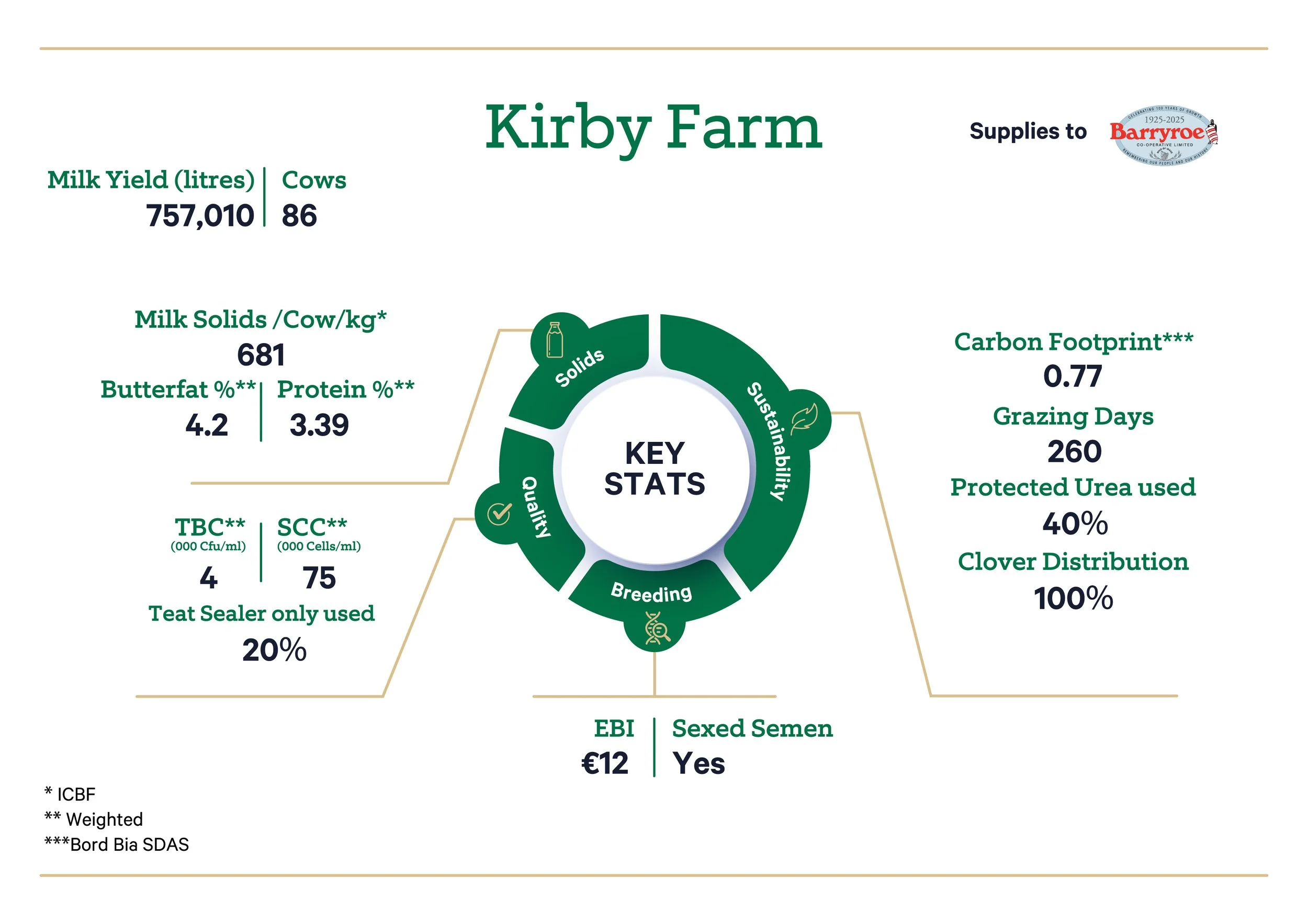
From their farm at Ballinascarthy, looking down towards Courtmacsharry, the Kirbys milk around 85 pedigree Holsteins. They are big-capacity cows bred to produce, averaging close to 8,900 litres, with 681kg of milk solids per cow, while consuming less than 1.5 tonnes of meal. Gerard Kirby has a wonderfully simple explanation for it: "Breeding beats feeding." It is a philosophy that runs through Mounteen. Rather than trying to feed performance into an ordinary cow, the Kirbys have spent years breeding the cow capable of delivering it. And these cows are expected to do something else increasingly valuable in modern dairying - last. Sixth, seventh and eighth lactation cows are nothing unusual here. The current herd averages around five lactations and the ambition is to push that towards six. Longevity matters economically, but it also says something about the way animals are managed. Cows rarely grow old in a herd unless fertility, feet, health, housing and stockmanship are all working with them.
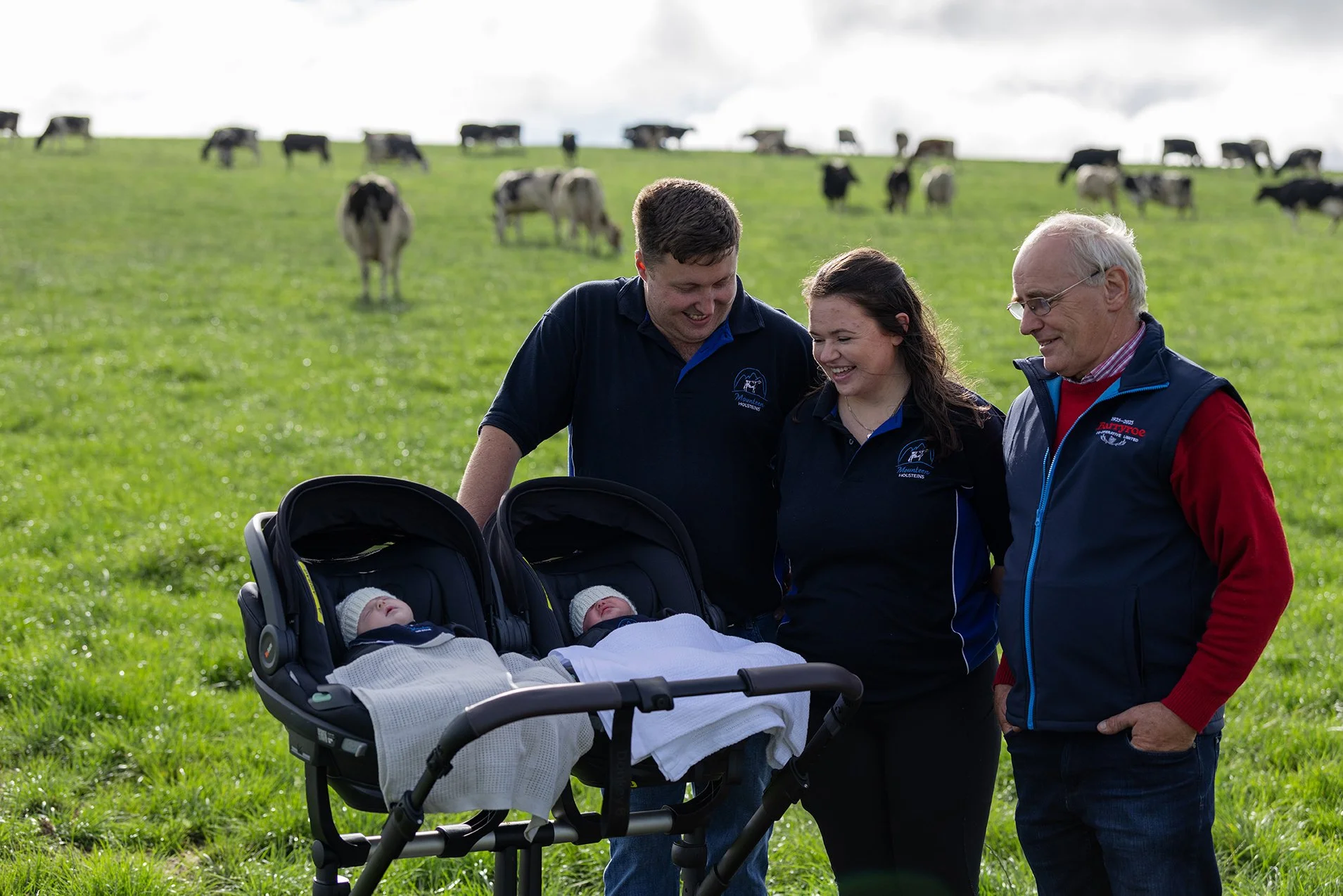
If breeding is the thread running through Mounteen, daughter Claire brings another dimension to it. A graduate in Dairy Herd Management from Clonakilty Agricultural College, she now works as an evaluator with World Wide Sires while remaining heavily involved at home. Her eye for cattle has also been tested well beyond the farm gate. She was National YMA Champion Handler in 2018, has won major showmanship and heifer titles, represented the IHFA internationally and represented Ireland in European young breeder competition. The Mounteen prefix has consequently become familiar in pedigree circles. The herd includes 14 cows classified Excellent, and showing has long been part of family life. There is no showing this year, however, for the happiest of reasons: Claire is expecting twins.
Claire's partner, Darragh Sheehy, brings another dimension to the livestock conversation at Mounteen. A dairy farmer in his own right, Darragh had only just returned from the breeze-up sales in France when the judges called, having sold a young thoroughbred with, he hopes, a racing future ahead of it. It made for one of the more unusual conversations of the judging tour. Around this particular kitchen table, opinions on pedigrees are certainly not confined to Holsteins, although we never quite established whether the racehorses were the sideline to the cows or the cows the sideline to the racehorses.
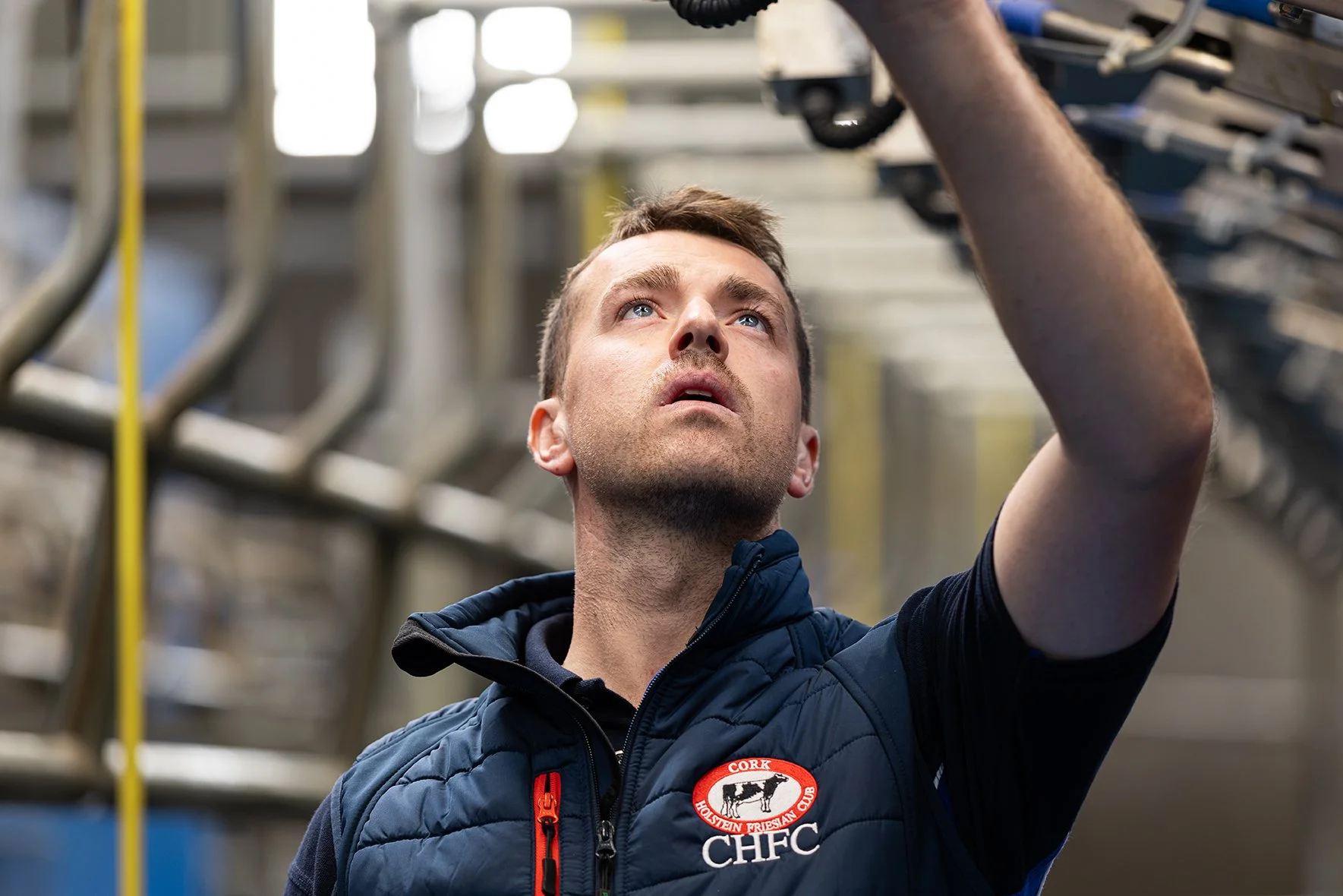
Whatever the pedigree, performance is what ultimately counts and back in the Mounteen dairy herd, the performance figures are difficult to argue with. Pedigrees and rosettes are enjoyable, but the unforgiving judge on any commercial dairy farm is the bulk tank. Here the Mounteen cows perform every bit as impressively. Throughout 2025, TBC results were consistently between 3,000 and 5,000/ml, while SCC was frequently in the 50,000-60,000 range and remained at remarkably low levels throughout the year. The same pattern continued into 2026. That doesn't happen by accident. Pre-spraying and wiping, post-milking disinfection and a disciplined plant-washing routine are standard. The 16-unit BouMatic parlour is only four years old, with capacity already built in for 20 units. Hot washing is carried out daily, descaling every fifth wash, and the dairy operates chlorine-free.
Selective dry cow therapy was approached cautiously rather than embraced because it was fashionable. The family initially tried teat sealer alone on selected cows, satisfied themselves that it worked and expanded its use. Their conclusion is characteristically practical: if the hygiene is right and the job is properly organised, it works. That combination of curiosity and caution crops up repeatedly at Mounteen.
The Kirbys know their cows individually, but they are perfectly happy to let technology help. CowManager collars monitor heat, health and temperature around the clock. The family's description of them is better than anything in the sales brochure: "It is like having an extra person in the yard." The system doesn't replace the stockperson's eye; it gives that eye another pair of glasses. Changes can be picked up earlier and the timing of AI sharpened. Breeding is carried out through DIY AI, with sexed semen used across all heifers and selected cows, while Belgian Blue and Angus genetics are used on the remainder. Heifers are weighed as they develop rather than growth being guessed by eye. And the results are visible at the youngest end of the herd too. Calf mortality was below 1% in 2025, with just one mortality recorded, following none in 2024. That is perhaps the best example of what makes Mounteen interesting: traditional stockmanship being sharpened rather than displaced by technology.
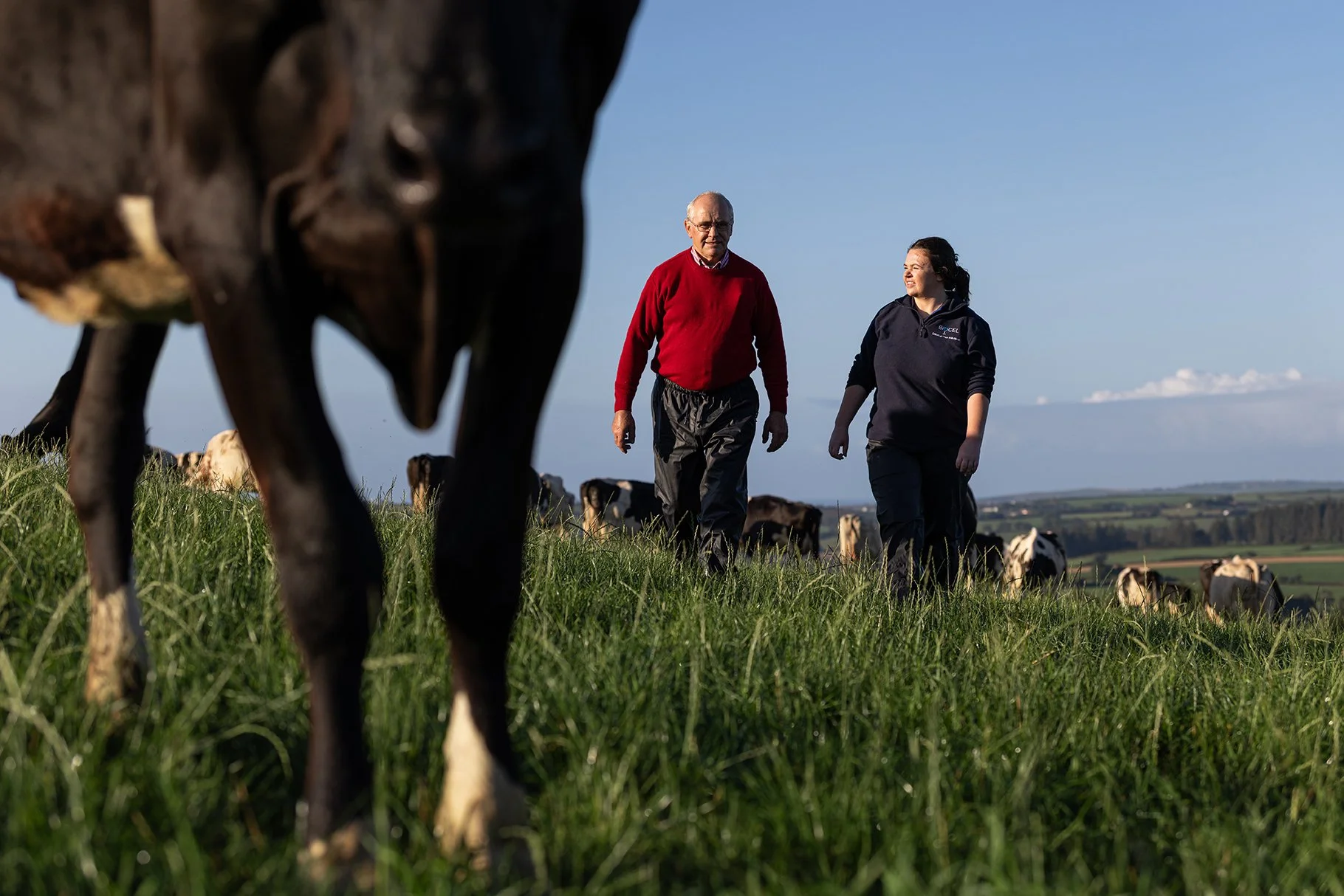
For all the emphasis on breeding, the cows still have to be fed. First-cut silage comes early - around May 10 - targeting 75-78 DMD, with additives used to preserve quality. Four to five acres of maize are grown and beet is bought in to complement the winter diet. Grass remains central. The farm is measured around 25 times a year, six hectares were reseeded in 2025 and clover has been incorporated throughout the grazing platform. The Kirbys record around 260 days at grass. The result is a relatively compact farm producing a considerable amount of milk without attempting to buy all of that production through the feed bin.
There is another number at Mounteen every bit as interesting as 8,900 litres: 0.77. That is the farm's carbon footprint in kg CO2 equivalent per kg of fat- and protein-corrected milk, reduced from 0.91 the previous year. And again, it has not come from one grand gesture. Protected urea, low-emission slurry spreading, soil testing, lime, GPS-guided nutrient application, variable-speed drives on the vacuum and milk pumps and LED lighting all contribute. Solar panels installed in 2025 have generated approximately 40,000kWh, while four batteries provide 20kW of storage capacity. But some of the nicest environmental work requires no technology at all. Some 350 hedging plants and 100 trees have been planted; bird boxes dot the farm; 4.5 acres have deliberately been left wild; biodiversity mapping has been completed; and the family is exploring a reed bed to filter water. It is an interesting combination: a farm determined to produce more efficiently from the cow while steadily reducing the footprint around her.
Perhaps the strongest impression at Mounteen, however, is that there isn't one Kirby farm manager. There are Kirbys. John looks after much of the breeding and tractor work. Theresa is central to the milking. Claire brings her professional breeding knowledge home with her. Gerard combines the farm with his work at Barryroe Co-op and machinery work, while the wider family steps in as required .And their interests extend well beyond the yard. John and Gerard are involved in competitive ploughing; Gerard has achieved considerable success and both volunteer at ploughing events. The family helps at Clonakilty Agricultural Show, while GAA and Macra feature prominently in life away from the parlour. Indeed, one of the more unusual pieces of farm planning at Mounteen has nothing to do with PastureBase, nitrates or milk price. With a 60:40 spring/autumn calving split, the Kirbys have managed the breeding season so that calving finishes in time for championship matches. There are some dates even dairy cows have to respect in West Cork.
Barryroe Co-op could have chosen a farm with impressive milk figures to represent it nationally. In Mounteen it has something more interesting: a family that still gets excited about breeding an exceptional cow, but is equally comfortable talking about carbon footprints, solar generation, sexed semen, sensors and biodiversity. The show ring may tell you whether a cow looks the part. At Mounteen, the bulk tank tells you whether she can do the job. And on both counts, the Kirby cows have quite a record.